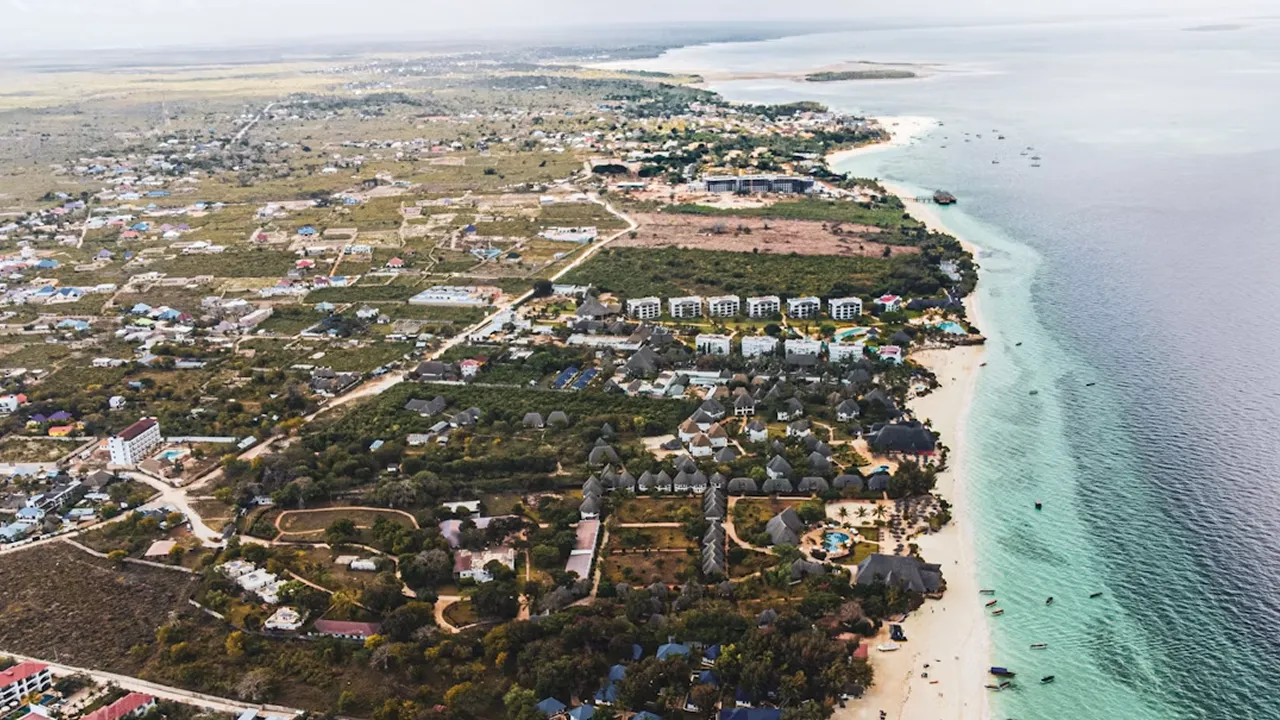
Zanzibar's property market has spent the last five years quietly becoming one of the most talked-about emerging stories in tropical investment, and 2025 was the year the headlines caught up with the fundamentals. Visitor numbers cleared 917,000 for the year, the one million annual tourist milestone has now formally been hit, foreign capital is arriving from three continents, and the legal framework that lets non-Tanzanian buyers hold property for 99 years has been refreshed twice in the past three years. For investors, Golden Visa seekers, and retirees weighing whether now is the moment to act, this annual outlook lays out what is actually happening across the islands. In this guide, we'll explore the demand drivers behind the boom, the price moves in each major area, the supply pipeline coming online, the risks an honest investor should weigh, and what the year ahead realistically looks like.
The forces driving the market right now
The single clearest driver is tourism, and the 2025 numbers leave little room for argument. The islands closed 2025 with 917,167 international arrivals, a year-on-year increase of nearly 25 percent over the 736,755 visitors recorded in 2024. The 800,000 visitor target the government had set for 2025 was cleared by August, and the one million annual visitor milestone Vela has been writing about as a forward projection for years has now formally been reached, with the 2026 Z Summit confirming a touch over 1 million arrivals and a tourism contribution of about $1.1 billion to the islands' economy. December 2025 alone brought in 100,729 visitors, up roughly 10 percent on December 2024, and August 2025 was the busiest month on record at 105,506 arrivals. January 2026 already came in at 100,216 visitors, a further 19.2 percent year-on-year jump. Tourists are also still staying longer, around 8 nights per trip, nearly double the typical stay in other Indian Ocean destinations.
This sheer volume of demand translates directly into rental performance. Hotel bed occupancy peaks above 90 percent in high season, and the broader picture is one of sustained year-on-year growth across nearly every month of 2025 and early 2026. Holidaymakers from Europe continue to dominate the visitor mix, accounting for 66 percent of arrivals in 2025 and 69.5 percent in January 2026, which sustains steady demand for upscale villas and beachfront apartments year after year. On an island-wide annual basis, average hotel occupancy ran around 62 percent in 2023, which is still the more honest number for working through a yield model when low season months are factored in.
Infrastructure is the second engine, and it is unusually busy for an island of this scale. Roughly $500 million has been allocated in recent years to upgrade roads, utilities, and airports, and the latest Zanzibar Investment Authority numbers cited at the 2026 Z Summit put the broader investment pipeline at roughly $14 billion across tourism, real estate, and supporting sectors. Abeid Amani Karume International Airport, which already handled 2.4 million passengers in 2024 and is projected past 2.8 million in 2025, is in the middle of a multi-terminal upgrade. A new passenger terminal valued at about $34 million with an additional 1.4 million passenger annual capacity is scheduled for completion in June 2026. The Terminal 1 upgrade is set to wrap by late 2025, and a refurbished VVIP and private jet terminal came online in October 2025. On Pemba, the Wawi Airport expansion is now underway, which extends the network beyond Unguja for the first time. A $230 million new deep-water port for northern Unguja is also in motion. Nearly 91 percent of visitors now arrive via direct flights rather than via a mainland stop. Read together, this is a country deliberately rebuilding itself as a standalone destination, not a side trip from Dar es Salaam.
The legal modernisation is the third force, and arguably the one that quietly changes the most for foreign buyers. The Zanzibar Investment Promotion and Protection Act, with 2023 updates, was followed by the Zanzibar Investment Act of 2023 and a further set of regulations rolled out into 2025. Together, these have streamlined approvals, formalised investor incentives, and reinforced the Zanzibar Investment Promotion Authority (ZIPA) as a single window for foreign property buyers. The Class C11 investor residence permit, introduced in 2024, has now moved into its first full renewal cycle, offering a 2-year renewable residency to foreigners investing at least $100,000 in approved projects. In 2025, Tanzania was removed from the Financial Action Task Force grey list following strengthened anti-money laundering controls, a reputational signal that international banks and institutional buyers tend to track closely.
Taken together, tourism volume, infrastructure spend, and a maturing legal framework are creating an unusually clear set of tailwinds. None of them have arrived overnight, which is part of why the outlook for the year ahead is stable rather than speculative.
Where the capital is coming from
The buyer mix is broadening, and that diversification is itself a piece of market news. Foreign buyers now account for nearly one-third of property transactions in Zanzibar, a share that has risen steadily over the past five years. ZIPA tracked transaction data shows the number of foreign investors purchasing property rose by 20 percent in 2024 alone, and the share of higher value deals (transactions of $200,000 and above) climbed from around 33 percent of foreign transactions in 2023 to roughly 40 percent in 2024. In short, more international buyers are arriving, and they are buying bigger.
The geographic spread is wider than many people assume. ZIPA-tracked transactions in 2024 and 2025 show that the top buyer nationalities are concentrated among Gulf nationals, Germans, Poles, and South Africans, with sustained interest from across Western Europe and a growing tail of buyers from the UK, the USA, and the Tanzanian diaspora. The Golden Visa programme is also pulling in a new segment, investors who might once have looked exclusively at places like Mauritius or Dubai for a residency-linked property buy, now adding Zanzibar to the comparison set. The combination of a $100,000 entry threshold and a renewable 2-year permit, set against Mauritius's $375,000 threshold for residency-linked schemes, has opened Zanzibar to a buyer who simply could not access those alternative markets at the same price point.
European holidaymakers continue to anchor the rental demand side, at 66 percent of arrivals in 2025 and nearly 70 percent in early 2026. That single statistic matters more than it looks. It means rental income is denominated, in practice, against the buying power of European travellers, and it tells the operator side of the equation what marketing channels, languages, and seasons to plan around. The slow rise of US and Gulf demand alongside that European core also gives an owner a wider booking funnel than they would have had even three years ago.
What prices did in the past year
Across the islands, the headline number through 2025 has been steady high single-digit to low double-digit growth in key areas, with the historic centre moving more slowly. In 2024 alone, residential property values jumped around 10 percent on average, outpacing even mainland Tanzania. Through 2025, the general market posted average annual price growth in the 8 to 10 percent range, while prime beachfront locations such as Nungwi and Jambiani extended their lead at roughly 10 to 15 percent. Beachfront land prices rose roughly 12 percent year on year in 2024 and held in a similar band through 2025, continuing a decade-long trend of about 13 percent annual price growth in sought-after areas like Nungwi Beach and Stone Town.
Looking at the longer arc, the Vela price index analysis, which sets 2019 as a base of 100, had the overall market reaching about 160 by 2024 and is on track to clear 170 by the end of 2025 once the year's gains are layered in. That is roughly a two-thirds gain in six years in nominal US dollar terms. The mix underneath that headline is the interesting part.
Nungwi, on the north coast, posted a compound annual growth rate of about 11 to 12 percent from 2019 to 2024, bringing its sub-index to around 176. The combination of all-season swimmable beaches, expanding hotel infrastructure, and limited development land along the coveted northwestern coastline has driven some of the fastest price gains on the islands.
Paje and the East Coast posted roughly 12 percent compound annual growth over the same period, putting the East Coast sub-index in the same ballpark as Nungwi at the mid-170s. Improved road access from Zanzibar City, the rise of kitesurfing as a global draw, and a wave of boutique villa projects have pushed values steadily upward.
Stone Town, the UNESCO-listed old quarter, grew at about 6 to 7 percent compound annual rates over the same five years, landing its sub-index in the mid 130s. The growth is calmer because conservation rules cap new supply and refurbishment is slower, but the trade-off is that the asset class is genuinely scarce.
Today's price per square metre figures give a clean snapshot of how that growth has reset entry costs. In Stone Town, simple refurbished apartments list for around $1,300 to $1,800 per square metre, and fully renovated heritage lofts in prime locations reach or exceed $3,000 per square metre. In Nungwi, beach area apartments typically sell for around $2,000 to $2,800 per square metre, while detached villas with private pools range roughly $2,200 to $3,000 per square metre, and luxury beachfront builds in 2025 have begun pushing into the $3,000 to $4,000 per square metre band at the top end. A recently built six-bedroom villa of 300 square metres near Nungwi Beach was offered at $692,000, working out to about $2,306 per square metre. In Paje, entry-level resort apartments start around $2,100 to $2,500 per square metre, and true beachfront villas on the east coast regularly command about $2,400 to $2,800 per square metre, with the most premium villas approaching the same $3,000 to $4,000 per square metre band seen in Nungwi. A recent live Paje listing of a furnished two-bedroom pool villa at 116 square metres was advertised for $259,000, or roughly $2,233 per square metre, which still sits in the lower quartile of current east coast valuations.
For a deeper look at how these area-level price moves translate into yields and a worked ROI, see the Zanzibar property price index and ROI benchmarks.
What the rental side looks like at these prices
Yields remain the headline that draws international attention to Zanzibar in the first place, and the spread between asset classes has held steady through 2025. Short-term vacation rentals in beach hotspots like Paje, Nungwi, and Jambiani routinely deliver gross yields of 12 to 18 percent per year when well managed, with most professionally run villas clustering in the 12 to 15 percent band. Stone Town apartments and well-located resort apartments generally land at 10 to 12 percent gross, and character apartments in the UNESCO core still clear 6 to 8 percent on long-term lets. Long-term rentals to expats, NGO staff, and local professionals in residential pockets like Fumba Town or Mbweni typically produce gross yields of about 7 to 9 percent on a conventional twelve-month lease.
The honest investor reads those numbers with a deduction in mind. Across the board, net yields after maintenance, management fees, service charges, and the modest annual land lease tend to come in roughly 1.5 to 2 percentage points lower than gross. A well-located beachfront villa grossing 14 percent commonly nets around 10 to 12 percent after costs. Worked through over a full year, a studio in Paje has been modelled to deliver about 13.6 percent at 50 percent occupancy and around 23 percent at 85 percent occupancy, which is a usefully wide spread for stress testing a model.
Occupancy is the variable that swings everything. Hotel bed occupancy peaked above 90 percent through the 2024 and 2025 high seasons, and 2025 saw new monthly arrival records as discussed above. The 2023 island-wide annual average was about 62 percent, which is still the more useful baseline for a full-year model that respects the spring rains. Professionally managed villas commonly hit 75 to 90 percent occupancy in the prime tourism zones of Nungwi, Paje, and Kendwa during high season, with off-season averages of 55 to 70 percent. Urban apartments in Stone Town tend to hold a steadier 65 to 80 percent annual occupancy thanks to expatriate and business traveller demand. Property managers typically charge between 20 and 50 percent of gross rental revenue, depending on the service level. None of these figures is exotic, but they all have to sit inside a model that the investor actually owns.
The supply picture
The supply story is the quiet hero of the Zanzibar outlook. New stock has consistently failed to keep up with demand, and the pipeline coming online over the next two years is small enough to keep that pressure in place.
Across the entire archipelago, only 600 to 800 new investment-grade units are expected to come to market across 2025 and 2026 combined. To put that in context, the broader housing gap on the islands is estimated at roughly 60,000 units, and the new development pipeline through 2030 is projected to add only 600 to 800 units a year. The supply that is arriving is also unusually concentrated. By mid 2026, the north coast resort zone is set to add about 240 apartments. The Paje and East Coast Corridor is bringing in roughly 74 new units, phased between late 2025 and mid 2026. A hybrid high-rise tower contributes about 138 apartments with handover projected for 2027. Scattered villa clusters in Jambiani, Michamvi, and Matemwe will collectively add fewer than 100 villas before the end of 2026. Mortgage rates of around 14 to 17 percent on Tanzanian shilling loans, with average central bank lending rates in the mid 15 percent range, restrict speculative development by smaller players and reinforce the dominance of larger, ZIPA-approved projects.
Where supply is arriving, it is concentrated in three obvious places. Fumba Town, on the southwest coast, continues to build out as a 1.5 square kilometre modern township planned for 5,000 residential units, with more than 700 homes finished in Phase 1 and roughly 500 additional units under construction as of late 2024. It will eventually include the Burj Zanzibar, a planned 28-storey timber eco tower set to be one of Africa's tallest wooden buildings. Blue Amber Zanzibar, the 411-hectare waterfront resort development in the northeast, was the first project granted Strategic Investment Status by the government and will feature hotels, a golf course, and private villas for sale on 99-year leases. Vela's own resort-style project at Paje, sitting on roughly 8,200 square metres just 300 metres from Paje Beach, sits inside this same group of approved, foreign buyer-ready developments.
Stone Town is the structural exception. UNESCO conservation rules and the fact that many heritage buildings are held by families across generations mean new supply is barely a trickle. That scarcity is exactly why Stone Town's sub index has crept up at 6 to 7 percent a year despite the slower headline growth rate, and why fully restored move in ready lofts in prime lanes have fetched over $3,000 per square metre.
The implication for an investor looking at the year ahead is straightforward. The supply ceiling is not a marketing line. With a pipeline of fewer than a thousand serious new units across the islands over two years, finite beachfront land in the markets that drive yield, and a structural housing gap measured in tens of thousands, the conditions that produced the last five years of growth are still in place.
Risks and headwinds an honest investor should weigh
The case for Zanzibar is strong, and that is precisely why the risks deserve a clean accounting. A flagship outlook that glosses over them serves no one.
Financing is the first practical constraint. Local mortgage rates of around 14 to 17 percent for Tanzanian shilling loans, with average lending in the mid 15 percent range, make traditional financing expensive. Loan-to-value ratios for foreign buyers are usually capped at 60 to 70 percent rather than the 80 to 90 percent advertised to local borrowers, which means most international buyers pay cash or use developer installment plans rather than borrow locally. That is workable, but it should be modelled rather than assumed away.
Seasonality is the second factor. Even with two peak tourist seasons and a record-breaking 2024, the island-wide annual hotel occupancy of about 62 percent in 2023 tells the full story. Spring rains and shoulder months pull occupancy down, and a model that assumes peak rates twelve months a year will not survive contact with the first low season. Plan for shoulder month tenants, expect to flex nightly rates, and stress test your model at 50 percent annual occupancy before committing.
Construction risk lives on the off-plan side of the market. Off-plan delivery in Zanzibar has matured rapidly, with established developers offering insured deposit structures and ZIPA-approved contracts, but delays still happen. The mitigation is consistent across the existing Vela articles: choose a reputable developer with a delivered track record, verify the ZIPA approval is genuine, and confirm that pre-completion payments sit in escrow or under international insurance until handover.
Currency exposure deserves a line. Most foreign buyers transact in US dollars and earn rental income either in US dollars (short-term holiday rentals) or in Tanzanian shillings (long-term tenants). For a European or UK buyer, that creates a real, if normal, currency risk between the home currency, USD, and TZS. Repatriation itself is straightforward, with no controls on profit repatriation through approved investment structures, but the conversion mathematics still need attention.
Regulatory friction is lower than in many comparable markets, but it is not zero. Every foreign purchase must clear ZIPA's no objection certificate process, the lease registration runs through the Land Commission, and certain coastal works require Zanzibar Environmental Management Authority clearance. The system works, but a buyer who tries to skip a step or use a creative workaround is the buyer who gets in trouble. For a longer treatment of how to avoid the common pitfalls, see the top mistakes foreign buyers make in Zanzibar.
Finally, build quality varies meaningfully across developers. The new build supply is concentrated in a small number of serious projects with proper amenities, escrow structures, and management capability, but there is a long tail of smaller developments where finishes, common area maintenance, and rental management are less reliable. The market is still maturing on this dimension. A buyer who chooses a project with a delivered track record and a proper management programme protects themselves from most of the issues that surface in the long tail.
The legal foundation matters more than ever
A market outlook that ignores the legal scaffolding underneath it is not really an outlook. Zanzibar's framework deserves a clean restatement because so much of the year ahead depends on it.
All land in Zanzibar is owned by the state, which means freehold ownership is not available to anyone, including local citizens. Foreigners buy on a 99-year leasehold, structured as 33-year terms renewable up to three times, with the lease registered as a title deed in the buyer's name. The Condominium Act of 2010 established this framework for foreign buyers in approved condominium developments, and the constitutional protection that underpins it has been in place since 2010. The Zanzibar Investment Act of 2023 and the 2025 regulations have layered further investor protections on top, formalising ZIPA's role as the single window and reinforcing tax incentives for strategic investments.
In practice, a registered 99-year lease grants the foreign owner the right to live in the property, rent it out (short term or long term), resell to another buyer (local or foreign), and bequeath the lease to their heirs. The leasehold is transferable and inheritable. For a full breakdown of how the structure works and what it gives a foreign buyer relative to freehold, see the 99-year leasehold explained.
The reason this matters for the year ahead is simple. Each successive piece of legislation since 2010 has reinforced rather than weakened foreign ownership rights, and the 2023 Act, with its 2025 regulations, is the most recent confirmation that the direction of travel is investor-friendly. A buyer signing in 2026 is buying into a framework that is genuinely more stable, with more formal protections, than the one available in 2019.
What the year ahead looks like
Pulling the threads together, the base case for the year ahead is one of continued growth on top of a structurally tight supply picture, with the precise rate depending on whether the 2025 tourism breakout is sustained.
On prices, the consensus base case across the major 2026 outlooks now sits in a 5 to 8 percent annual range for the general market, with prime beachfront locations such as Nungwi and Jambiani projected at 8 to 12 percent. The Africanvestor's 2026 base case puts cumulative gains by end of 2026 at 10 to 15 percent on coastal and UNESCO zone homes, with gross rental yields holding in the high single digits to low teens. The more bullish scenario, which assumes the formalisation of a true Golden Visa programme, faster delivery of the airport upgrade, and continued growth in direct flights from Europe and the Gulf, projects prime beachfront price gains of 15 to 20 percent over the two-year window, with Stone Town heritage units perhaps 12 to 15 percent. Even bearish scenarios do not anticipate nominal prices falling, given how tight supply is.
On yields, the base case is for short-term beachfront yields to remain in the 12 to 18 percent gross range, Stone Town and resort apartment yields to remain in the 10 to 12 percent gross range for modern stock and 6 to 8 percent for heritage units, and long-term residential yields to remain in the 7 to 9 percent gross range. Net of management fees, service charges, and tax, the well-managed beachfront villa should continue to deliver around 10 to 12 percent net.
On the demand side, three things are worth watching. First, the new passenger terminal at Abeid Amani Karume International Airport, due for completion in June 2026, will add 1.4 million annual passenger capacity on top of the 2.8 million the airport is already handling, which removes infrastructure as a binding constraint on tourism growth for the rest of the decade. Second, the Class C11 investor residence permit introduced in 2024 is now into its first full cycle of renewals, which will give the market a clearer read on whether the Golden Visa programme is creating durable buyer demand or just one-off transactions. Third, the diversification of buyer origin (Gulf nationals, Germans, Poles, South Africans, with a growing tail from the UK and the USA) reduces the risk that any single source region cooling off would derail the cycle.
On the supply side, the obvious watchpoint is whether the next wave of approved developments delivers on schedule. The big anchor projects (Fumba Town's continued build out, Burj Zanzibar's progress, Blue Amber's roll out, and the new Paje wave) all matter, both because they add visible inventory and because their delivery confirms or revises the timeline that investors are modelling against. The 2026 Z Summit's headline of a $14 billion investment pipeline across tourism and real estate suggests the development funnel is widening rather than narrowing.
On the risk side, the points to revisit annually are the FATF status (Tanzania is currently off the grey list as of 2025), the stability of the ZIPA approval cadence, and any movement in the local mortgage rate environment that would change financing economics for the small share of buyers using local debt.
Sitting with all of this in front of you, the year ahead for Zanzibar real estate looks like a continuation of an established trend rather than the start of a new one. The legal framework is more refined, the buyer base is broader, the infrastructure is steadily improving, and supply remains genuinely tight. That combination has produced strong price growth and double-digit yields for six years running. There is no obvious catalyst that breaks it in the next twelve months, and several that strengthen it.
Final thoughts
The Zanzibar property market in the year ahead is best understood as a maturing emerging market with very clear fundamentals, not as a speculative play. The forces driving it (record tourism that has now formally cleared the one million annual visitor mark, sustained infrastructure investment with a new airport terminal due in mid 2026, refreshed legal protections, and a diversifying foreign buyer base) are visible and durable. The mathematics underneath it (roughly two-thirds price growth in six years, 12 to 18 percent gross beachfront yields, a pipeline of fewer than 1,000 serious new units over two years against a 60,000 unit housing gap) is striking by any global comparison.
For the investor, this points to a window that still favours early movers, especially in areas like Paje and Nungwi where supply pressure is sharpest. For the Golden Visa seeker, the combination of the $100,000 threshold, the 2024 introduction of the Class C11 permit, and the 2025 regulatory reinforcement creates one of the most accessible residency by investment paths available globally. For the retiree, the same legal stability that supports investor returns also supports a long-term home that can be passed to heirs without losing its rights.
Ready to take the next step? Vela's team is here to help you translate the year ahead into a property choice that fits your goals, whether that means a studio in Paje, a beachfront villa in Nungwi, or a heritage apartment in Stone Town. Reach out for a personalised conversation, and we will walk you through the developments, the projections, and the legal pathway from offer to title deed.
Karibu (welcome) to Zanzibar's year ahead.

